

Occipital Nerve Blocks: Treating Migraines
Occipital nerve block gets a page of its own. This is the one place I may sound like a charlatan, like I offer a miracle cure.
Anyone who gets frequent migraines knows that they can be disabling and difficult to treat. There is a treatment that is so easy and so safe it sounds too good to be true. What’s the down side? The medical industry has labeled it an “anesthesia procedure”and charges hundreds of dollars, making it unaffordable. In my mind this is unbridled greed at its most telling.
An “occipital nerve block” is what the name sounds like. The greater occipital nerve comes up the back of the skull on either side of the middle. For reasons that are completely beyond my understanding this nerve is integral to the migraine process.
For most people with migraines - in my experience probably 70-80% - numbing this nerve on both sides will break the migraine. It acts fast: within minutes the pain is subsiding, very often the nausea and mental cloudiness too. If you watch someone you will see the tension on their face melt. People with migraines that occur primarily in the face may have less benefit, but that is not consistent. People with predominantly abdominal migraines tend to benefit also. (I don’t have experience using this for vestibular migraines, but would recommend trying it.)
But the best part is that, for many people, these shots will reduce migraines in the near future. For some people they work for a few days, others weeks, and for some, months.I have seen regular shots, with decreasing frequency, help someone go from daily migraine to rarely getting them. (What’s the classic disclaimer - *Results may vary.)
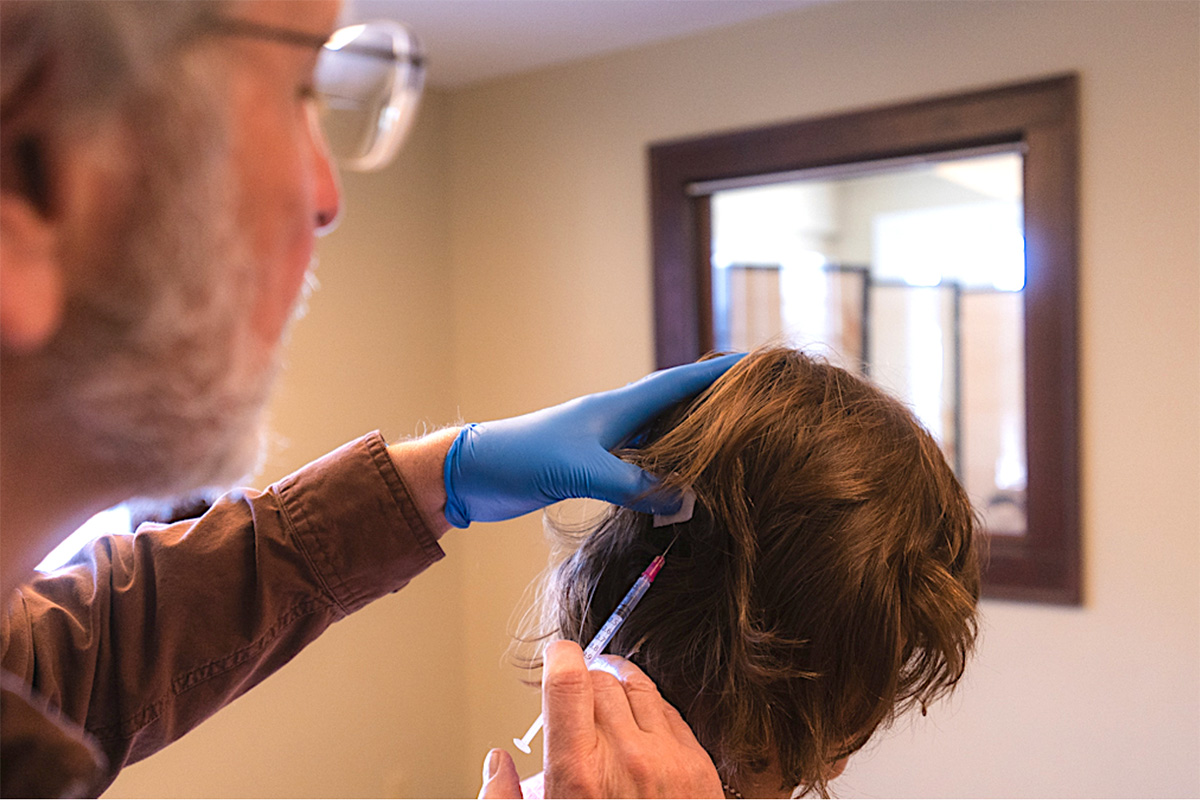
The procedure itself takes about 5 minutes. It involves finding the spot (occipital notch)where the nerve crosses a ridge on the back of the skull (superior nuchal line) and injecting about 1 cc of lidocaine there, doing on each side. That’s it, it’s really that simple. So simple that I’ve taught some people (or their partners) to do their own.
Risks: Any time a needle goes through the skin there’s the potential to cause an infection, something I’ve not seen happen from these shots. If you use a small needle and inject over the skull I can’t think of any way you can do real damage. (If someone was in the wrong place, below the skull and used a long needle, it’s possible to inject by the spinal cord - but you’d have to really try to mess up.) The worst that I can think of is injecting the lidocaine into a vein; because I move the needle around no more than a fraction would go in. While in theory lidocaine can cause a seizure in a susceptible person, the amount of lidocaine used is less than you would receive to suture a cut. Any substance, including lidocaine, has the potential to cause a severe allergic reaction - so small a risk that it usually isn’t even mentioned. In other words, risks are little to none, so much so that I have my students practice the procedure on me.
This is very different from botox shots. Botox requires tiny injections in a large number of spots. There is a risk of paralyzing one or more muscles for a period of months. It has to be repeated every few months on an ongoing basis. It takes a long time and is expensive, typically in the $1000-2000 range per session. But it’s promoted and it’s covered by insurance, and it works well for some people.
My goal is to promote awareness of this treatment and to make it available to as many migraine sufferers as possible.