

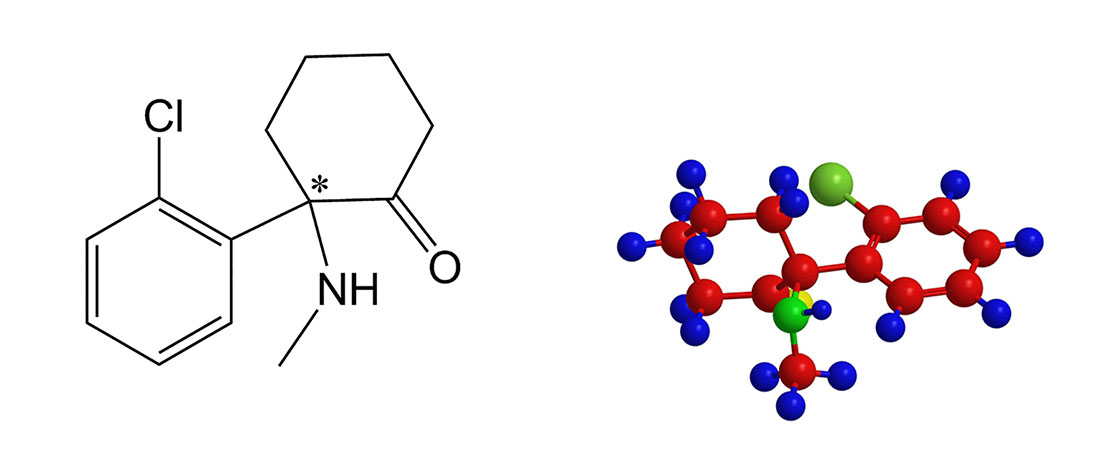
Ketamine, the drug
Ketamine is a drug that was FDA-approved in 1970. It was devised for anesthesia: it’s a “dissociative” anesthetic, and unlike other anesthetic drugs, it doesn’t suppress breathing except at very high doses. The person is awake, it’s just that the consciousness is someplace very different from the body.
At low doses ketamine is commonly used for pain, such as in the emergency department and ICU. As the dose goes up, so does the effect on the psyche. A medium dose is “psycholytic,” that is, it alters perception and thought, and softens neural connections, without taking the person away from their physical reality. A higher dose is dissociative, psychedelic. This is where the “trip” occurs. And at even higher doses it is an anesthetic.
Ketamine is FDA approved for anesthesia. It isn’t FDA-approved for psychiatric uses; however, there is a type of ketamine, s-ketamine, that is approved as an antidepressant as a nasal spray.
How it’s given: IM, IV, SubQ, orally, nasally
Ketamine can be administered many ways. Ketamine clinics tend to use IV (intravenous) treatment. It has the advantage that the dose can be adjusted as you go. More important, if side effects occur the infusion can be turned off. That isn’t true for the other routes. But it requires more supplies and equipment and a medicalized setting.
For psychiatric purposes it’s commonly given IM (intramuscularly, in the arm), usually in at least 2 doses to spread out the effect. It is simpler and less resource-intensive (read: expensive) than IV, with a predictable response to the drug. This is the primary route used at Journey to New Hope.
A route that we use frequently, but is not as common, is subcutaneously (subq, SC), into the fat below the skin, like insulin. This gives a gentle onset, like the oral troches discussed below, but with reliable absorption. I will often use this as a first dose, especially the first time a client receives the drug. For a full dissociative journey this will be followed either by a second SC dose, or more likely, an IM dose.
A common way it’s given is orally-dissolving troches (lozenges). Used this way, the drug has to be held in the mouth for about 20 minutes to allow absorption through the lining of the mouth. At the end of that time it should be spit out. Absorption is variable, depending on how well the person keeps it in their mouth and swishes it around the membranes. It is often used to give a lower level of effect, the “psycholytic” level, in a counselor’s office to do therapy under the influence of the drug. The disadvantages are that it can taste bad, you have to hold it in your mouth for a long time, and it’s unpredictable how much you actually absorb. Additionally, it can only be supplied by a compounding pharmacy, which is a big hassle for the client.
It is sometimes taken orally by pill. This is not as effective; absorption is unpredictable, and the drug is absorbed so slowly that there can be a drawn-out “tail” of the experience.
Ketamine can be given by nasal spray; this requires a compounding pharmacy to make it. Again, how well it is absorbed can be affected by congestion, how well the client sniffs when spraying, how cold or dry the air is, and so on. This may be the least predictable route and is not used at this clinic.
Side effects
The most common “side effects” of ketamine, when used medically, are hallucinations, dissociation, and so on - the very thing that we are using it for. But there are significant medical side effects that can occur. Short-term side effects with administration like what is done here include:
• High blood pressure. Blood pressure can spike pretty high with ketamine, especially in men and people over 50, and especially in people with hypertension.
• Nausea and vomiting. This is especially true for people who are prone to motion sickness.
• Bladder pain and irritability.
• For people with heart conditions, it can cause heart rhythm issues, which can be serious or fatal.
People with schizophrenia and certain other psychiatric conditions should never receive ketamine because it can worsen their disease. This is one reason for the extensive screening process.
Ketamine can also cause a prolonged “tail” effect, with difficulty functioning the next day. It becomes really important to discern your state before driving or making decisions in the days following the journey.
With long-term use, especially with regular use like micro dosing or recreational use, more serious side effects can occur:
• Bladder damage with long-term bladder pain and dysfunction
• Mental changes with loss of some mental capacities
• Liver damage
• Long-term stress on the heart with damage to the muscle
For how the drug is administered here, the main medical concern is cardiovascular: high blood pressure and stress on the heart. Blood pressure will be monitored, and in some cases a heart rhythm monitor will be used.